
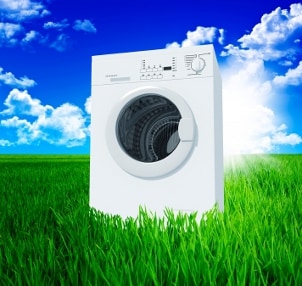
Green Washers and Dryers:

- Washers: Energy and water consumption in the home can be greatly reduced by using energy-efficient washers and dryers. There are a few things to look for in your future washers.
Features of Green Washers:
- Front-load washers: With a horizontal or tumble-axis basket, front-load washers lift and drop clothes into water instead of using a central agitator. This means that front-load washers use less water and less energy to heat it.
- Redesigned top-load washers: These redesigned washers use a different washing action to clean clothes. Look for washers with sensors to monitor incoming water temperature and washers that use repeated high-pressure spraying instead of soaking clothes in a tub of water.
- High spin speeds: The faster your washer can spin the clothes dry, the less moisture will remain in them, which means less energy spent to dry them in the dryer.
- Front-load washers: With a horizontal or tumble-axis basket, front-load washers lift and drop clothes into water instead of using a central agitator. This means that front-load washers use less water and less energy to heat it.
- Dryers: When online shopping for dryers, look for these features:
Features of Green Dryers:
- Moisture sensor: This will prevent you from over-drying your clothes and wasting energy.
- Removable lint filter: Make sure you can get to the lint filter for cleaning. Clean your lint filter after every load to maximize the dryer's efficiency.
- Variable temperatures: Switching from hot to warm or cold can reduce a load's energy use by half.
- Moisture sensor: This will prevent you from over-drying your clothes and wasting energy.
- Updated dishwashers: An easy way to save at least $30 a year in utility costs is to replace a dishwasher that was made before 1994 with a more energy-efficient model. Most of the energy used by a dishwasher is used to heat water. When looking around for a new dishwasher, check out Energy Star-rated dishwashers. They use less water and 25 percent less energy than, making them a very eco-friendly home appliance.
Features of Green Dishwashers:
- Let dishes air-dry: Many dishwashers have an air-dry switch. If your dishwasher doesn't, turn off your dishwasher after the final rinse and prop open the door to let your dishes dry without heat.
- Avoid soaking or prewashing: Soaking or prewashing is really only recommended for dried-on or burned-on foods. You can save water and energy by soaking and prewashing dishes by hand in the sink.
- Avoid using the "rinse hold" switch: Using the rinse hold switch, especially on just a few dishes, can waste several gallons of hot water.
- Wash full loads: Make sure your dishwasher is full but not overloaded. Washing full loads will maximize your washing while minimizing the amount of water you use. Overloading usually results in dishes that aren't clean, and this means another cycle through the dishwasher.
- Let dishes air-dry: Many dishwashers have an air-dry switch. If your dishwasher doesn't, turn off your dishwasher after the final rinse and prop open the door to let your dishes dry without heat.
- Energy-efficient fridges: As far as energy consumption goes, your refrigerator uses the most energy in your home. Increase your home's energy efficiency with a new refrigerator or freezer with an Energy Star rating and other green qualities.
Features of Green Refrigerators and Freezers:
- The right size for your kitchen: The larger the model, the more energy it will use. The most efficient refrigerator models usually have a capacity of 16 to 20 cubic feet, and the most energy-efficient freezers are chest freezers.
- Top-freezer models: Refrigerators with top-freezers use 10 to 25 percent less energy than side-by-side refrigerators.
- Automatic moisture control: This feature is designed to prevent moisture accumulation on the cabinet exterior without the addition of a heater. Automatic moisture control is not the same thing as an "anti-sweat" heater, which uses five to ten percent more energy.
- Manual defrost: Can you defrost your refrigerator or freezer by yourself? How about when you find out that manual defrost models use half the energy of automatic defrost models? (Frost buildup raises the amount of energy needed to keep the motor running, so don't let frost build up more than one-quarter of an inch.)
- Avoid extras: Consider buying a refrigerator without an ice-maker and through-the-door dispenser. Those extras cause the unit to use 14 to 20 percent more energy and raise the cost of your refrigerator by $75 to $250.
- The right size for your kitchen: The larger the model, the more energy it will use. The most efficient refrigerator models usually have a capacity of 16 to 20 cubic feet, and the most energy-efficient freezers are chest freezers.
- Heaters: Keeping your home properly heated or cooled is a concern for just about everyone. Here are some things to look for in your heaters.
Features of Green Heaters:
- Ceramic-element space heater: This space heater can be operated at a lower temperature, releasing the same amount of energy, which will spread over a larger area. Ceramic heaters are able to maintain higher temperatures for longer periods of time than electric heaters.
- Oil-filled radiators: The heating element is contained inside the heater, and once the oil is heated, it will continue to give off heat even after the inner element has been turned off. Because these heaters do not have a fan, they run quietly.
- Infrared-based space heaters: Using the energy from infrared, air is passed through coils, which then heat a room. These portable heaters can be moved from room to room or wherever a little extra heat is needed.
- Halogen space heaters: These heaters are also known as reflective heaters. They use an energy-efficient halogen bulb, but instead of heating a room, they heat nearby people and objects. These portable heaters are usually housed in cool-touch cases, have a double safety grill and feature automatic tip-over protection, which makes them perfect for homes with kids, animals or the elderly.
- Ceramic-element space heater: This space heater can be operated at a lower temperature, releasing the same amount of energy, which will spread over a larger area. Ceramic heaters are able to maintain higher temperatures for longer periods of time than electric heaters.
- Air conditioners: Central air units can be expensive to run, especially if you only need to cool a few rooms. Consider using an energy-efficient room air conditioner. When you are shopping for a room air conditioner, look for the following features.
Features of a Green Air Conditioner:
- Energy Efficient Ratio (EER): The highest EER will provide the greatest savings. EER is the cooling capacity of your air conditioner in British Thermal Units (BTUs) divided by the watts.
- Special circuits: The standard home outlet has a connection for a 115-volt branch unit circuit. Any AC units rated at 115 volts may need a dedicated circuit, and any room units rated at 230 volts will need a special circuit.
- Easy-to-clean filters: Filters that slide out are easier to clean regularly, which will keep your air conditioner working efficiently.
- Controls: Air conditioning units with controls, such as digital readout thermostat settings and built-in timers, will help you adjust your air conditioner to use less energy.
- Energy Efficient Ratio (EER): The highest EER will provide the greatest savings. EER is the cooling capacity of your air conditioner in British Thermal Units (BTUs) divided by the watts.
Green Dishwashers:
Eco-friendly Refrigerators and Freezers:
Energy-efficient Heaters and Air Conditioners:
Tip from Overstock.com:
- Proper maintenance will go a long way toward keeping your energy-efficient home appliances working like new. Always remember to clean filters regularly and perform standard upkeep on your new housewares. The money you'll save in utility bills will more than offset the little bit of maintenance you do, as well as the initial cost of these more eco-friendly home appliances.


